Liner notes:
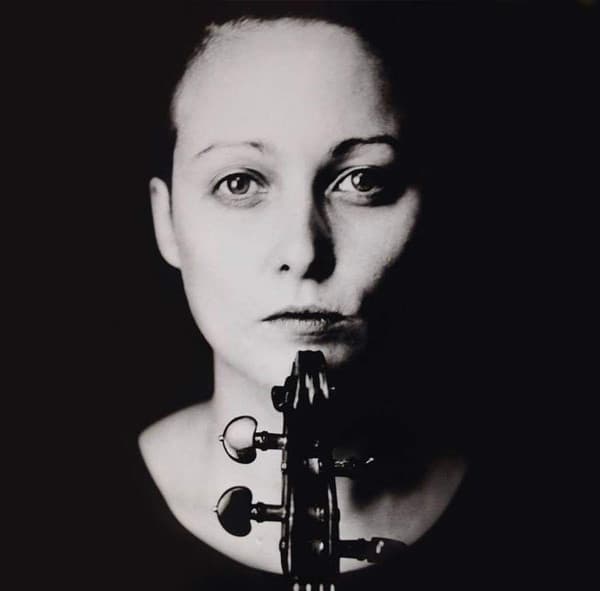
Tijana Stanković (born 1984, now with the name Golubović) is a violinist, vocalist, ethnomusicologist and improviser based in Belgrade in Serbia.
Already as a young kid, she had classical violin training. Growing up surrounded by traditional songs from the Balkans, she started playing and singing folk music at the age of 15. This interest led her to study Ethnomusicology at the Academy of Arts in Novi Sad. Even though improvisation was always close, it wasn’t until 2011 — after a workshop with Hungarian Mezei Szilárd — that she started working with free improvisation.
Her musical world is rich. You’ll find her working with contemporary composer Iancu Dumitrescu, and singing in the a cappella Serbian folk group Pjevačka družina Svetlane Spajić, among many things. And when it comes to free improvised music her approach stands close to folk music in a nearly dualistic way, with tension created between the poles of traditional/contemporary, ritual/abstract and fixed melodies/improvisation. When starting to blend these, as it seems, different approaches, Stanković soon saw similarities. In a way, she tells me, improvised music also works like folk music: there is no writing, and you nearly always play together with other people (even though she works alone here). But maybe even more importantly, in both approaches she saw how certain models or motifs were recurring, often without the performer even thinking of them. In seeing similarities between the way melodies are used in an un-notated traditional context, and the way an improvisor is using their own dictionary of musical motifs and textures in an improvised context, she started combining these approaches. This could be heard on her solo debut Freezer (LOM, 2020), and also on this follow up, recorded at a FRIM concert at Fylkingen, Stockholm in April 2022. The music on Freezer was, she explains, a result of thinking in “a long, long musical sentence”.
The same works for the FRIM concert, even if the result is even more free. From specific folk songs Stanković creates something very earthy and raw, but also delicate and beautiful. The dualism of her voice and her prepared violin and bow is extraordinary in its rich blending of the ritual and the abstract. When it comes to the songs, you find beauty in Song for the Bees (Za Pčele), where Stanković finds inspiration from a ritual song sung when collecting bees to the beehives, rawness in the energetic and droney Song for the Queen (Kraljička) which also is ritualistic, but from the field of carnival with people singing and dancing in the streets. Kontra is more traditionally performed, and so is the melodic part of Jano Mori, songs from Croatia and Macedonia respectively. In using elements of Balkan folk music, the overall musical environment of Stanković has a unique quality compared to the old style of fragmented West-European improvised music that was stipulated the Free Improvisation scene in the 1970s.
The use of drones, for example, is an effect of her great interest in the heterophonic “izvika” style that can be found in specific forms of Serbian traditional music. In its use of long tones and microtonal variation of melodies, it has more similarities with other Non-Western heterophonic music, such as Arabic traditional music, Gamelan and Japanese Gagaku. Incorporating this into the world of free improvised music is a blessing.
– Magnus Nygren
released May 24, 2024
Tijana Stanković — violin, voice
All music by Tijana Stanković (STIM/NCB).
Recorded April 14, 2022 at Fylkingen, Stockholm.
Recorded by John Chantler.
Mixed and mastered by Guiseppe Ielasi.
Cover design and layout by Ryan Packard.
Produced by FRIM.
Tijana Stanković grew up with traditional songs from the Balkans. She developed taste in harsh, abstract improvisation which shaped her present repertoire. Her key tools – violin and vocal / traditional and contemporary music – are equally incorporated in every band, orchestra or free formation she is involved with.
In addition to that, studies of Ethnomusicology at the Academy of Arts Novi Sad, Serbia broaden her interest in folk music. After attendance of Mezei Szilard’s "Levegő-Vazduh-Air" workshop held at Novi Sad (Serbia) 2011, she started working on free improvisation. Collaborations with musicians, composers and artists: Mezei Szilárd, Márkos Albert, Iancu Dumitrescu, Ana-Maria Avram, Nikolaus Gerszewski, Sőrés Zsolt (Ahad), Ivan Čkonjević, etc. Past and ongoing projects: Argo - rebetiko-free improvisation project based in Budapest; Pjevačka družina Svetlane Spajić - folk music a cappella group; Rođenice – a cappella; playing in Dor – folk-free improvisation band, Hyperion Ensemble (INT); Mezei Szilard’s Improvisers Orchestra, as well as Túl a Tiszán Innen Ensemble and Identity’s Dream Quartet; Nikolaus Gerszewski's Korpovit Trio; duo with Sőrés Zsolt (Ahad), duo with Kutas Reka (cello, Vienna), duo with Luka Toyboy (electronics), duo with Miroslav Toth (composer, saxophonist from Bratislava), duo with Ana Kravanja (violin, Slovenia), duo with Lenhart Tapes (tape music, SRB).
From the year 2002 until 2007 she played in the Subotica based band Paniks, which performed in major festivals all over Europe. In March 2019, she begun working on Radio Beograd 2, as an author on “Od zlata jabuka”, show on folk music. Her solo album "Freezer" was published in 2020 for the Slovakian record label LOM. In 2021 she renew the collaboration with Lenhart Tapes with whom she is working on sophisticated and wild mix of folk tunes and harsh noise, with elements of contemporary classical music and free improvisation. (2022)